Time Isn't Your Enemy
a framework for keeping your why, what, and how in conversation with each other

Conditions for Be(com)ing provide prompts for returning to the work of becoming.
Time these days frequently feels like an obstacle, an enemy to vanquish in the work of transcending or escaping limits. And it’s true: time is the absolute constraint on our lives. The speed at which our hours pass, the rapid cycling of years, feels both commonplace and surprising. Not to mention: we have no idea when our years will end, but that they end is no surprise. We feel the boundary of time every day.
Time is a condition of our becoming in that it brings us to make choices, to narrow the fields in which we will live, work, play, and relate to one another. We can either rage against the dying of the light, or we can make friends and collaborate with this reality.

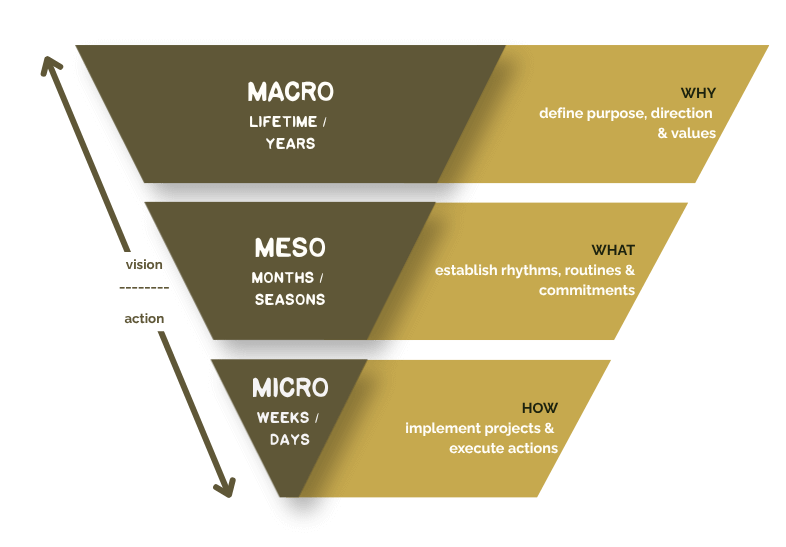
It may help to understand time as three different layers: the macro, meso, and micro. Most productivity advice implicitly holds all three, without always making clear which layer does what work in your life. Talking about why, what, and how helps us notice and do particular things at the appropriate layer.
Macro is the lifetime layer. It holds our purpose, direction, and values: the stars by which we steer our lives. Some find this in a faith tradition; others find it in a set of fundamentals or principles. The macro layer is the long view, the higher vision. It allows us to be reflective and divergent, seeing what’s possible before narrowing anything down. What lives within this layer changes slowly and provides you with a lodestone for your journey. Advice and practices that focus on “finding your why” live in this layer.
Meso is the seasonal layer. This could be months or years shaped by the commitments you’re carrying or considering. It holds rhythms like a new professional role, school schedules, or a kid’s sports season. It’s where you discern which opportunities are actually yours to take, which projects get built and when. Things change seasonally (hopefully proactively). Strategy, habits, and commitments live in this layer. When we talk about “what,” we’re talking about the structures and commitments that hold your life for a limited period, that reflect how you’ve chosen to live out your “why.” Tactics and techniques that focus on project management work at this layer.
Micro is the immediate layer. The weeks and days that get all of your energy, that sometimes seem like the whole of life. Choices here reflect the macro and meso layers: what you’ve decided to say yes and no to, how you practice staying present to what’s in front of you. Changes happen quickly here, and sometimes we respond without remembering our why and our what. Many productivity tools and techniques such as to-do lists, time blocking, and distraction management work at this layer.
These three layers of why, what, and how aren’t separate management problems. They’re meant to stay in conversation with each other.
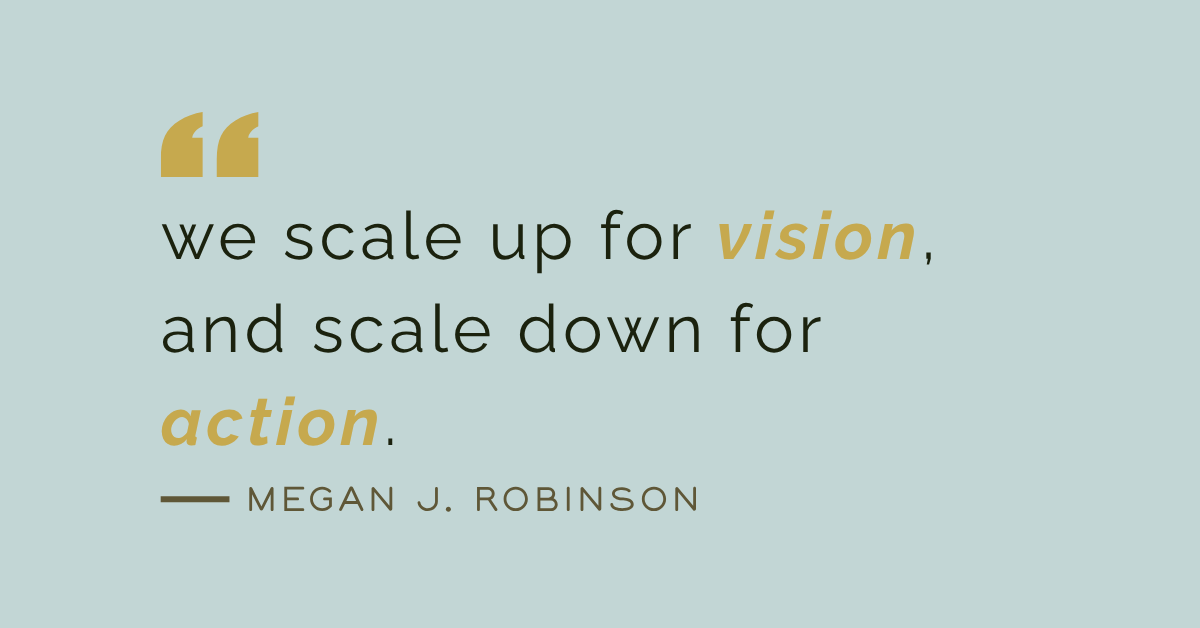
When you’re lost or scattered in the day-to-day, that’s not a micro problem to solve with better task management. It’s a signal to scale back up to macro and re-clarify what you’re actually oriented toward. And once you have that clarity again, you scale back down: the vision has to inform this week, this hour, or it isn’t doing anything.
You’re not working with three separate tools, but rather, one instrument that you keep tuning: asking, at any given moment, which layer you’re actually operating on, and whether the frustration or stagnation you’re feeling belongs there, or on another layer.
Sometimes it feels like we should make these choices once and be done forever. Communicating across layers takes energy and time. But it’s this back-and-forth communication that creates who you’re becoming. Discerning your why, what, and how invites a constant return to the practice of listening to your life and noticing what it tells you.
Because we always need reminders to return to the work of be(com)ing.
If you’re curious about how to communicate across time, I offer a Wayfinding Session to help you listen to your life.
Let’s be hopeful, creative, and wise—together.
Shalom,