

Van Gogh and the Infinite Desire
What Van Gogh's life can teach us about desire and formation


People Watching explores what it looks like to be a flourishing human through the relationships that shape us. I share conversations from real folks about the role models they’ve found in their everyday lives, and “character references” from historical, fictional, and contemporary folks who shed light on what it looks like to live with purpose in any age.
There’s the old proverb that you “should never meet your heroes.”
I wouldn’t say that Van Gogh was a hero, exactly, but I’ve always loved the energy of his paintings, and found what little I knew of his story intriguing. So at the end of last year, I decided to read Van Gogh: The Life, an exhaustive biography by Steven Naifeh and Gregory White Smith.
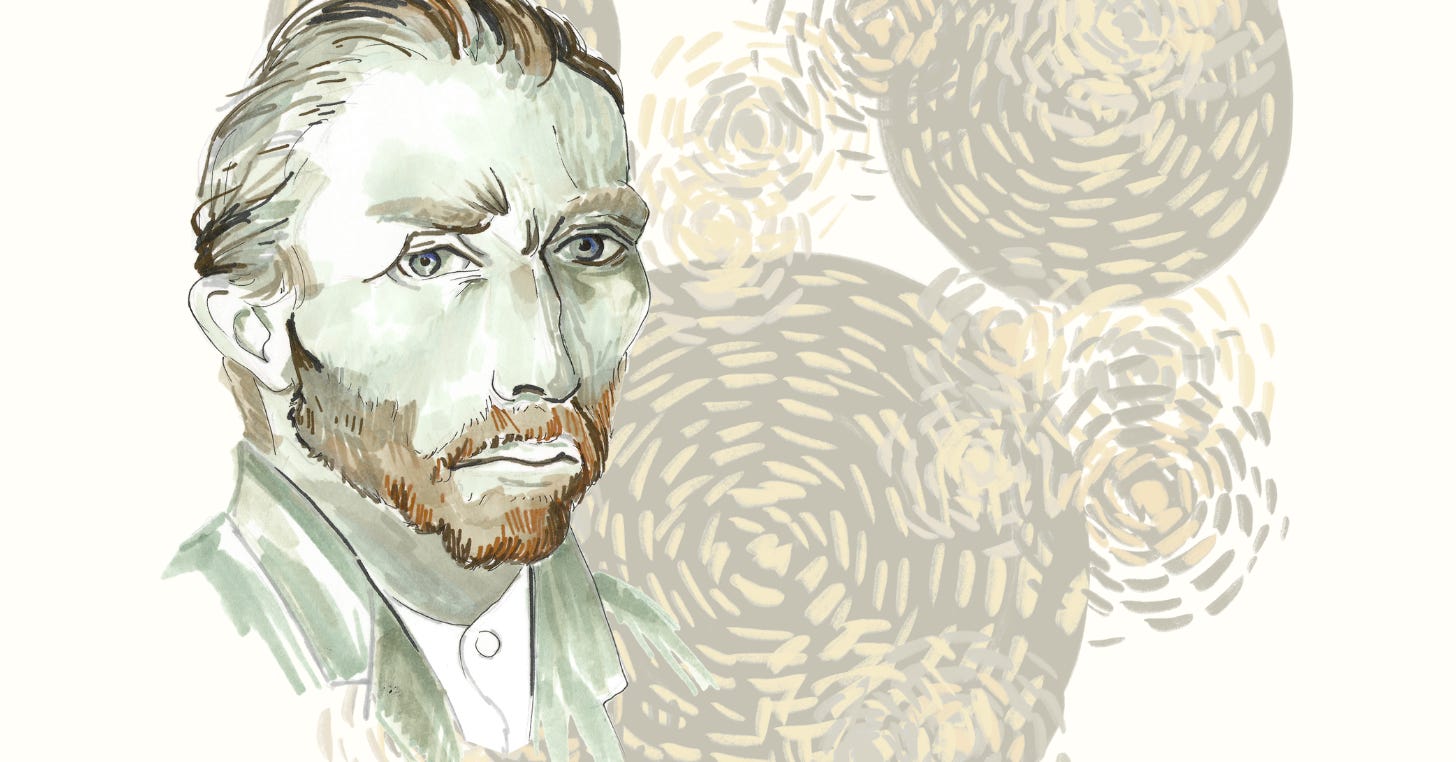
Vincent Van Gogh lived a tragic life. He grew up in a time, culture, and family that emphasized conformity, productivity, and religious piety, and that punished any perceived deviations with silence and ostracism. To be clear, Van Gogh did not make himself easy to get along with.
He romanticized and idolized various women in his life, putting them on pedestals then tearing them down. He berated his brother Theo in one paragraph then praised him as saintly and perfect in the next. He endeavored to launch a creative commune in Arles, France, and briefly lived with Paul Gaugin before driving Gaugin mad with his madness. Strangely, the one thing that everyone else knows of Van Gogh’s life (cutting off his ear) is the one thing I completely forgot.1 But every effort at connection with other human beings went sideways, made him appear strange and intense to the people he most wanted to love.

He was a voracious reader and observer of the world around him, and the sheer volume of his self-education in art over a lifetime astonishes when you consider that his available resources were produced and distributed at human speed. But for all his insight, he refused to do anything but graphite drawings in his early career, refused to listen to other artists and practice differently, refused to even consider that he might have something to learn. I was astonished at how long he resisted painting before it became the only thing he could do, before he became the “Van Gogh” we know today.
What struck me most as I read was his desperate desire to belong and be welcomed for who he was. Yet he appeared incapable of seeing another human being as a person, with their own longings and challenges. Everyone he met served an archetype: every rural laborer was a noble savage; every artist a priest of divine vision. This refusal to meet others as others left him bereft of relationships that would have helped him discern and navigate his desire.
If desire signals our capacity for the infinite, Van Gogh contained an infinite desire. He lived his life reaching for the stars, and found mostly stones. And I suppose found a purpose in the struggle to make something of his life with that desire. We can never know “what might have been,” but I closed his story wondering what could have happened had he gotten true help, or found one welcome.
Who models healthy or unhealthy desire for you?
Let’s be hopeful, creative, and wise—together.
Shalom,
It appears he did so due to a combination of mental instability, absinthe, emotional anguish, and syphilis.