


If you appreciate what you read here, you can find a path for further exploration at the end of this issue.
I have long had the suspicion, the sense, the inkling, that there’s something incomplete, or just wrong, about the (now-memed) sentiment that “nobody wants to work.” There are, of course, many who would prefer (and manage) to get something for nothing, or with as little effort as possible. I personally love to invoke Newton’s first law of motion by remaining still and at rest for as long and as often as I can.
My suspicion as to this inaccuracy stems from the accumulation of things like Wikipedia, YouTube, community gardens, volunteer organizations and efforts, hobbies, and the like: the products of massive voluntary investments of time, energy, attention, and capital (social and financial). In a word—work.
With some exceptions, nobody gets paid for these products. In the lingua franca of our time, what’s the ROI here? With the acceleration of AI and its evangelists promising that it will, variously, replace human workers and unleash an explosion of human work in its most democratic form (it’s not clear to me how it does both), the question becomes: what kind of work is the human person meant to do? What is work for?
What follows are various and connected theses for thought, lightly held. Feel free to challenge or extend them as you will.

01.
In his 1893 lecture to the Hammersmith Socialist Society, artist and activist William Morris offers a theory of work organized around three hopes: for results, rest, and pleasure.
Does the process produce a tangible, beneficial outcome for yourself and others?
Does it allow you to relax in time and ways that are proportionate to the effort?
Does it give you pleasure in exercising your energy, skill, experience, and imagination?
Morris makes the distinction between useless toil and useful work, which we can understand as a spectrum according to the degree to which the effort fulfills each of the three hopes. More rest, results, and pleasure: useful work. Less of all three: useless toil. A job (employment) can be found at any point on this spectrum, as that for which time and labor are exchanged for money. Everything human persons do is work of some kind or another: our action in the world, for both survival and flourishing. It is the expectations that we bring to the work that shape our experience of it: whether we find it beautiful, tragic, alienating, or helpful.

02.
Much of our contemporary white-collar employment seems to skew toward the toil end of the spectrum, what David Graeber pithily calls “bullshit jobs.” These jobs feel meaningless, either because the results of our effort are minimized or obscured, and/or because nothing about the job needs or requires us as a unique and specific person to do it. The last 150-plus years of education and professionalism have created a pipeline of persons trained and shaped to fit a specific social contract. That contract rewarded all parties for providing compliant cognitive workers for an industrialized economy: education and training produced standardized expectations to which corporations and resumes could be matched accordingly. At a systemic scale, our socio-economic lives are entangled with extractive and exploitative choices and practices that push harm out to every member and segment of society, especially to the most vulnerable and least powerful.1
03.
AI is apocalyptic. It reveals what the pandemic cracked open in its years-long pause: the freedom for many to acknowledge that their jobs fell on the useless toil end of the spectrum, and they were no longer willing to keep pretending. On the employee side, the effort of performing and masking for financial security and self-actualization, at the expense of time, values, health, relationships, and sanity, no longer feels like a trade worth making. On the corporate side, the veneer of provision for, or connection to, persons no longer makes sense on the spreadsheet when a tool exists that can do some of the work faster and doesn’t require benefits, sleep, or relationship.2 Hence the apocalypse in both its senses: an ending and a revelation. But of what? Perhaps the opportunity to “consciously uncouple”3 jobs from work, so as to imagine and rehearse different futures for both.
04.
The conversation around “AI and work” is variously described as being about “finding or building the good life,” freedom, creativity, and progress. At its core, this conversation circles the question: who, or what, is sovereign? Who can provide results, rest, and pleasure? The person? The corporation? The technology? Something else? To be sovereign is to be completely autonomous, capable of determining the how, what, where, when, and why of a given thing, such as a life. A person or entity is sovereign when it can (among other things) provide food to others, not as reward or threat, but as sustenance, as gratis for the fact of being alive. AI appears to offer sovereignty, but its ability to provide results, rest, and pleasure remains to be seen. In the Christian story, God alone is recognized as sovereign; human persons receive a delegated sovereignty, an ambassadorship of the divine kingdom. The “AI and work” conversation highlights an enduring tension found in Christian theology: the exploration and explanation of God’s sovereignty, and our efforts to claim more than this delegated sovereignty for ourselves. We might understand it as the 21st-century version of the tower of Babel: the use of technology to ascend to the heavens, to become gods ourselves.
Though now long estranged,
Man is not wholly lost nor wholly changed.
Dis-graced he may be, yet is not dethroned,
and keeps the rags of lordship once he owned.
[…]
The right has not decayed.
We make still by the law in which we’re made.- from Mythopoeia, J.R.R. Tolkien
05.
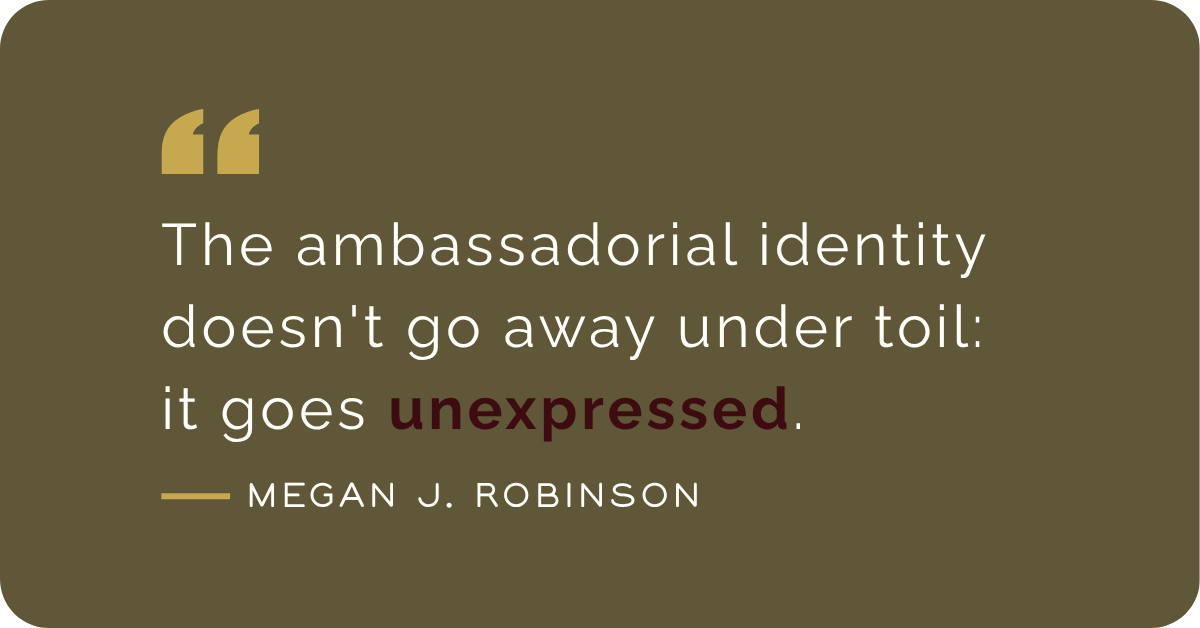
Continuing in the Christian story, we can follow the thread of this human reaching for absolute sovereignty back to the first three chapters of Genesis. These chapters describe the relationship between God and the persons he sets within the created world: the divine presence at rest within the household of creation, and in community with his ruling stewards, his appointed ambassadors for the world’s care and cultivation. The crisis of these chapters describes the rupture of that relationship: the rejection of received sovereignty, the corruption of care and stewardship, and the suffering that unspools from there. “Ambassador” is the natural, rightful role and activity of the human person. Useful work is ambassadorship in action when it’s not corrupted or severed. Toil, then, isn’t just bad or undignified work. It’s the non-expression of the truest thing about the human person. The ambassadorial identity doesn’t go away under toil: it goes unexpressed. The sense of meaninglessness or fungibility in our jobs acknowledges the “rags of lordship” we wear in our desire to perform useful work. The appearance of sovereignty offered by AI expresses the corruption of that desire.
I will not treat your dusty path and flat,
denoting this and that by this and that,
your world immutable wherein no part
the little maker has with maker’s art.
I bow not yet before the Iron Crown,
nor cast my own small golden sceptre down.- from Mythopoeia, J.R.R. Tolkien
06.
The evangelists of AI, who claim for it both revolution and replacement, would have a world in which humans conform to the image of the database: interchangeable digital bytes that can be stored, sorted, and deployed at will. The intersection of AI and employment occasions a particular path: to submit to the totalizing view that everything can be optimized, and that human making exists to be flattened to technique and technology, to inputs and outputs. We can call it the Iron Crown: the demand for everything to be subjugated under its dominion, all making and working bent to fit its shape and logic. It is a logic of fungibility, a sovereignty of sameness. Yet human making resists this logic in its persistent desire for rest, results, and pleasure. Human making, the work of work, is the exercise of our ambassadorial role: we work in unique and specific (non-fungible) ways so as to fulfill our part in the divine household. We wield our own Golden Sceptres in recognition of a lordship that persists, and is no less significant for its rags and decay.
Blessed are the timid hearts that evil hate
that quail in its shadow, and yet shut the gate;
that seek no parley, and in guarded room,
though small and bate, upon a clumsy loom
weave tissues gilded by the far-off day
hoped and believed in under Shadow’s sway.- from Mythopoeia, J.R.R. Tolkien
07.
To refuse to bow before the Iron Crown, to resist its totalizing dominion, requires human persons to both receive and give rest, results, and pleasure. It is to recognize that our delegated sovereignty invites us to share sustenance and autonomy, not to hoard it (for in hoarding we perpetuate harms that ripple outward). Doing so means a return to the divine household as the site of refusal and rehearsal: the refusal of extraction and exploitation, and the rehearsal of different futures. Our jobs are a single site of ambassadorial practice, but they are not the whole; in treating them as the only one, we unwittingly accept the logic of the Iron Crown. To uncouple human work from employment, to stand against such logic, we must raise our Golden Sceptres in the ordinary, unglamorous, unheroic, and local expressions of ambassadorship as our first site of rehearsal. We must shut the gate against the path of optimization and flattening, and by our work, create new paths for the divine household in the wider world.
I spent weeks into months researching, thinking, and writing around this question of what work is for,4 on top of years of hazily wondering why “work” so often felt miserable, and why it served as the cornerstone of contemporary life. The incursion of AI into employment, further destabilizing an already-shaky and uncertain moment, made this a particularly live question. My drafts folder is littered with the detritus of false starts, quasi-answers, darlings I couldn’t bring myself to kill, and the constant realization that the essay(s) I kept trying to write were not the essay that needed to be written.5 The books Sabbath Gospel and Worth Doing especially gave me a vocabulary to finally begin answering this question, helping me realize that work is both more important and more mundane than the stories we so often tell around it. While some aspects of the question no longer buzz quite so loudly in my mind, it’s clear that this is only the beginning of further exploration.
What do you think?
Let’s be hopeful, creative, and wise—together.
Shalom,
Your Path for Exploration
If this essay resonated with you and you’d like to leave a receipt for the ideas you underlined in your mind. → The Receipt Jar
For those times when you learn something really important, and then find yourself asking, “So, NOW what do I do?” → Prompts for the practice of be(com)ing
For a conversation to help you make sense of your personal journey: where you’ve been, where you’re going, what you’re focused on right now. → The Wayfinding Session
We are all of us complicit in some way, and innocent in others. It’s a real Gordian knot.
Ah, Gwyneth. Bless.

This essay is in conversation with:
Sabbath Gospel: A New Narrative of Time, Rest, and the Work of the Church, by G.P. Wagenfuhr and Emy J. Erickson
Worth Doing: Fallenness, Finitude, and Work in the Real World, by W. David Buschart and Ryan Tafilowski
Useful Work vs. Useless Toil, by William Morris
Institutionalized Education as Cognitive Offloading, by Stefan Bauschard
How AI Makes Us Sovereign Slaves, by Chris Watkin
The Gen-Z Backlash Against AI is Real and Justified, by Jim Amos
“The traditional social contract linking education to job security has collapsed”: Norma Sancho, Substack Note
Where the Future Actually Comes From, by Jasmine Bina
How Work Became a Job, by Aaron Jacob
The End of Work, by Anna Levitt
Is AI Going to Destroy Our Lives or Not?, by Kyla Scanlon
AI as Christian Heresy, by L.M. Sacasas
The Third Act of Work, by John Fechtel
Why Work is Starting to Look Medieval, by Sierra LaDuke (YouTube)
The Nature of Meaningless Work, by Alex McCann
Why We Fear AI and Toolmen, by Mandy Brown
Monopoly Round-Up: The Rage of the Billionaires Is Coming, by Matt Stoller
I have receipts!