

When Your To-Do List Becomes a Zombie Horde
Human Be(com)ing • A client case study on projects that won't die & planning before chaos hits

Human Be(com)ing explores how to desire better, decide wisely, and act differently in an often overwhelming and bewildering age.
Rachel laughed when she told me about her Monday. Not the delighted kind of laugh—the slightly unhinged kind that happens when you’ve spent 200 minutes in a car, juggled four different schedules, and realized you still haven’t planned your son’s birthday party that’s happening in two weeks.
“Every week is different,” she explained. “And I don’t know if my son will get invited to cross country meets until the week of. So I have to be somewhere at 8 AM on Saturday, but I won’t know until Thursday.”
She paused. “Soccer never really stops. There are maybe six weeks of the year we don’t play soccer.”
Six weeks.
I asked what she wanted to leave our coaching session with.1 Her answer: “I need a plan for the things that are going to need executing this fall. My concern is we’re going to hit December and I’m going to hate myself again.”

Why Your Projects Keep Coming Back from the Dead
Want More Brainsss…
Rachel’s situation isn’t unique. The specifics differ—maybe your version involves aging parents instead of soccer schedules, or work travel instead of cross country meets—but the pattern holds.2
We have events, schedules, and plans that we know are coming up, but somehow, the tyranny of the urgent keeps us feeling like we’re running on a treadmill. We even know what would help: making a plan and a schedule so that we can do both the urgent and the important. Yet somehow that plan never materializes and the treadmill keeps on humming.
I’ve started calling these “zombie projects.” They never die, never finish, just keep shambling forward demanding our attention at exactly the wrong moments. The Sunday school curriculum that needs planning. The birthday gifts for December. The meal planning everyone depends on. The organizational systems we know would help but can’t seem to maintain.
They’re not dead. But they’re not really alive either. They’re just…there. Consuming energy. Creating decision fatigue. Giving us a good jump-scare right when we least expect it.
Zombies suck.
When Worlds Collide
During our session, Rachel shared that she’d been trying to work from home all summer with kids constantly interrupting. “Mom, can you drive me here? Can you pick this person up? I have weight lifting.” She was attempting to maintain work focus while managing a household in constant motion, working from coffee shops between kid activities, trying to squeeze in evening work time that disappeared once school started and she was commuting everywhere.
“My energy is more focused when everything’s not meshing together,” she realized. But contemporary life specializes in making everything mesh together—work and home, planning and executing, thinking and doing. We’re supposed to context-switch seamlessly, maintain focus despite interruptions, and somehow also be present to the relational moments that actually matter.
As wonderful as it can be to work from home,3 it’s hard to keep responsibilities clear when the boundaries are this porous. Everything bleeds together.
Maybe projects aren’t the only zombies here.
Maybe we’re being asked to become zombies ourselves: undead workers who never tire, never need rest, never say “enough.” We’re supposed to stay switched-on 24/7—perpetually available for work emails and kid questions and household decisions, endlessly productive across all domains, with no off-switch.
The cultural assumption runs deep: find the perfect system, implement it consistently, watch your life run smoothly. When it doesn’t work—when August looks nothing like November, when your kid’s cross country schedule throws everything off, when you abandon your helpful evening prep because you’re too tired—you assume you’ve failed.
But what if the system failed us first?
What if it was never designed for actual human life? For bodies that tire. For minds that need rest. For people with seasons of capacity and seasons of depletion. For creatures who can’t maintain the same energy output regardless of circumstances—because we’re not machines. Or zombies.
Planning for the Jump-Scare
Don’t Fight Alone
There’s a moment in Rachel’s story that keeps returning to me. She’s describing her ideal scenario for family meal planning: “A shared document. ‘This is where this information is. Don’t ask me.’ Or if they do ask me, I at least don’t have to think about it. I can just pull this up and be like, ‘Here.’”
She’s not asking to escape family life. She’s asking to not be the single point of failure for every household decision while also managing her own work and commitments.
Christian scriptures speak often about bearing one another’s burdens.4 But somewhere along the way, particularly for women in family systems, “bearing burdens” morphed into “being the brain for everyone else’s life while also living your own.”
This isn’t sustainable.
But the answer isn’t to eliminate all planning or responsibility. Rachel’s evening prep genuinely helps when she does it. Her spreadsheet for Sunday school curriculum two years ago made the entire teaching season more sustainable. The physical tools she’s collected for attending soccer games (the giant Stanley water bottle, the wagon for chairs) have made those hours more manageable.
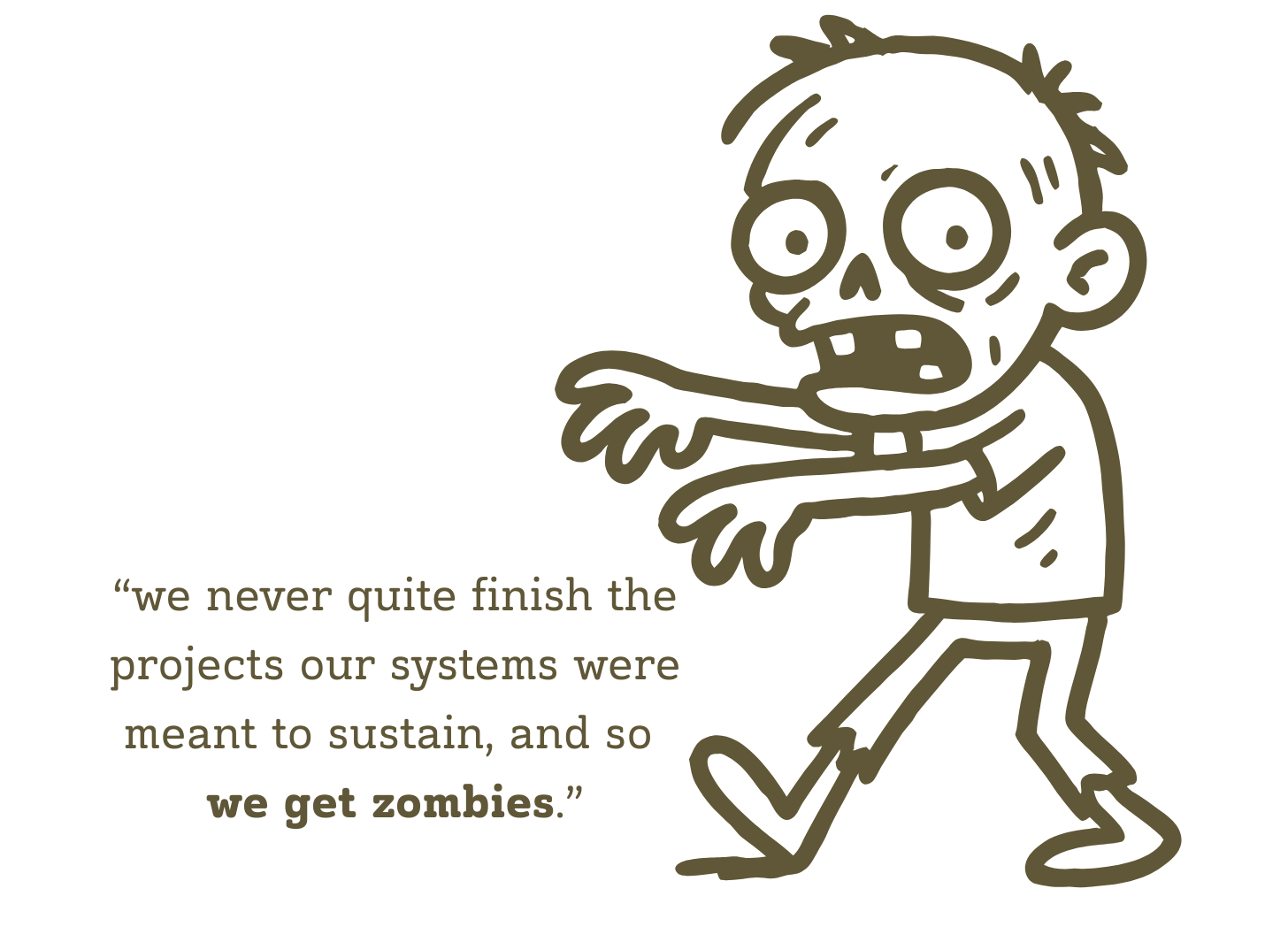
It’s not that systems don’t work. It’s that we implement them when we have capacity, then abandon them precisely when we need them most. So then we never quite finish the projects those systems were meant to sustain, and we get zombies—shambolic undead consuming our mental energy without ever releasing us.
The Proactive Paradox
“I want to be more proactive rather than reactive,” Rachel said in our first session.
But here’s the paradox: we can only be proactive when we have a small window of capacity before the reactive season hits. Once we’re in it—once school starts and you’re driving 200 minutes a day, once the holidays arrive and you haven’t bought gifts, once the crisis is in full swing...it’s too late.
It’s straight-up survival now—the zombie horde is upon us.
This is why December keeps arriving and we keep hating ourselves. We knew it was coming. We knew we’d need gifts and plans and mental space. But we were busy being reactive to September and October, and we never grabbed the August moment to think ahead.
Some religious traditions observe a liturgical calendar: seasons, rhythms, and rituals that have a specific focus and purpose. In the Christian tradition, Advent prepares us for Christmas. Lent for Easter. The wisdom isn’t just spiritual—it’s deeply practical. It’s hard to be present to the holy moment if we’re frantically scrambling to prepare for it.
The same holds true for our human-sized lives.
You cannot be present to your kid’s conversation in the car if you’re mentally scrambling to figure out dinner. You can’t enjoy teaching Sunday school if you’re planning the lesson the night before. You can’t enter the holidays with peace if you’re shopping on December 23rd.
This kind of intentional preparation isn’t just logistics; it’s purpose in action. Purpose gives us something to move toward, a vision of who we’re becoming that puts our current circumstances into context. Rachel isn’t just trying to survive December. She’s trying to become the kind of person who can be present to her family during Advent, rather than frantically managing gift deliveries and last-minute shopping trips.
Purpose helps us notice the difference between managing tasks and stewarding a life.
Being proactive requires a countercultural, purposeful reframe: accepting that our capacity is limited and planning accordingly. It means looking at the calendar and saying, “I will have approximately zero mental space between September and November. What needs to happen in August?”
It means recognizing that some seasons are for planting and some are for harvesting. We can’t do both simultaneously, no matter how much productivity culture insists we should.
Escaping the Zombie Project
A Different Way Forward
What if the goal isn’t doing more but living well?
Here’s where purpose becomes essential—not as optimistic aspiration, but as practical filter. If purpose gives us a destination and helps us measure our choices, it also helps us make hard decisions between equally good options.
Rachel faces this constantly: soccer or cross country? Evening work or family dinner? Sunday school curriculum planning or career development? These aren’t choices between good and bad—they’re choices between good and good. Without a clear purpose against which to evaluate them, every choice feels equally urgent.
So purpose acts as a filter. It lets us ask: Which option better enables me to move toward who I’m designed to become? Which honors my creaturely limits while still investing in what matters? Which problems are actually worth solving right now?
What if instead of managing ten ongoing projects poorly, we clearly defined three that align with our actual purpose, gave them end dates, and actually completed them?
What if we built systems in seasons of capacity specifically to support ourselves in seasons of depletion—not randomly, but guided by clear conviction about who we’re becoming?
What Makes Us Human
There’s a moment late in our conversation where Rachel brainstorms about a possible solution: “I could buy a binder and sleeves and print out recipes and grocery lists and tab them. That’s not hard. That would not be hard to do.”
She sounds almost surprised. Like she’d been making it too complicated.
We often mistake complexity for sophistication. We think good systems must be elaborate—multiple apps, intricate workflows, perfect optimization.5 But Rachel’s best solutions were remarkably simple: evening prep with highlighters. A physical binder everyone can access. A spreadsheet made once and referenced all season.
Wisdom involves understanding what the moment requires and responding appropriately. But doing so requires a clear sense of purpose strong enough to filter the overwhelming array of choices modern life offers. We have access to infinite options—projects, commitments, opportunities, good causes. The internet gives us 24/7 access to every need, every idea, every possibility.
Without purpose as a filter, we drown in options. With it, we can evaluate: Does this move me toward who I’m designed to become, or does it just look important because everyone else is doing it?
Purpose provides a standard by which to evaluate our choices. It lets us ask whether our present actions—our zombie projects, our evening prep practices, our decisions about what to finish and what to kill—align with our deeper convictions about who we’re designed and called to become.
Not over-engineering. Not under-preparing. Just wise attention to what’s actually needed.
Rachel’s situation reveals a hard truth about what it means to be human in the 21st century. We’re navigating genuine complexity—multiple kids with overlapping schedules, work that matters, relationships that need tending, bodies that tire, households that require management. This isn’t manufactured difficulty. It’s real life.
And real life requires something beyond optimization: it requires honest assessment of our creaturely limits and strategic choices about where to invest our finite energy.
When Rachel said, “I think when I’m stressed, I don’t like being the person that gets come to,” she’s naming something deeply human. We all have capacity limits. Under stress, those limits contract further. This isn’t failure—it’s design. We are not meant to be infinitely available, endlessly capable, constantly “on.”
But we live in a culture that treats human limits as problems to overcome rather than realities to honor. So we keep trying to do more, be more, manage more. And our projects become zombies because we never actually finish them—we just keep them barely alive while starting new ones.
Staying Present (Without Being Undead)
Purposeful Presence
So how do we stay present to what matters when the logistics threaten to drown us?
Again, we return to our purpose: as destination, standard, and filter.
As destination: Purpose reminds us we’re moving toward becoming people who can be present—not perfectly organized, but purposefully oriented, even in September’s chaos.
As standard: Purpose gives us a measure for evaluating whether shooting that zombie project in the head aligns with who we’re designed to become. Sometimes killing a project isn’t failure—it’s wisdom.
As filter: Purpose helps us choose which projects deserve our finite capacity right now, and which equally good options need to wait for a different season.
Rachel’s evening prep practice isn’t just time management. It’s a daily act of aligning her choices with her purpose: becoming someone who can shepherd her family well, teach Sunday school with presence, and do meaningful work—all at a human scale, all within her creaturely limits.
An Invitation
Take a look at your own life. What projects have become zombies—neither dead nor fully alive, just consuming energy without resolution?
What would it mean to shoot one in the head? To actually finish it or deliberately abandon it, freeing that mental space for what matters now?
And what’s your version of evening prep—the simple practice that genuinely helps when you do it, that your brain tries to convince you isn’t necessary?
Maybe this is your August moment. The small window before the chaos hits when you can think ahead rather than just survive.
What needs planning now so you can be present later?
And underneath it all: What’s your purpose—your actual destination, not your aspirational one? Who are you designed and called to become? Let that answer guide which projects deserve your August attention.
Take a look at how you responded to last week’s SloDo. Has anything from this essay illuminated, transformed, or otherwise changed about your response?
Let me know how it goes for you.
Let’s be hopeful, creative, and wise—together.
Shalom,
This case study and general details are shared with the client’s permission.

Seriously, I love it.
Galatians 6:2