



Human Be(com)ing explores how to desire better, decide wisely, and act differently in an often overwhelming and bewildering age.1
Some email providers may cut the text in your inbox. Fully visible on the web!
Ah, 2026. You’ve promised yourself that THIS is the year you make that change you’ve been wanting to make in your life—the reading change, the health change, the adventure change, the change to rule all changes. THIS IS THE YEAR.
Meanwhile, your workplace has already had its strategic planning sessions, and you’ve submitted your OKRs for the first quarter (possibly even all four quarters). You’re trying to figure out how to accomplish your personal goals alongside your professional ones. And all the while you’re thinking about how to quietly quit All the Things, because you’re just TIRED of being told to optimize and improve and stay on the fucking treadmill.
You may find yourself sitting in traffic on your evening commute, wondering what it’s all for. What is the point of goals and objectives and results, and all the hustle?2
That, my friends, is a fantastic question. We should ask it more often.

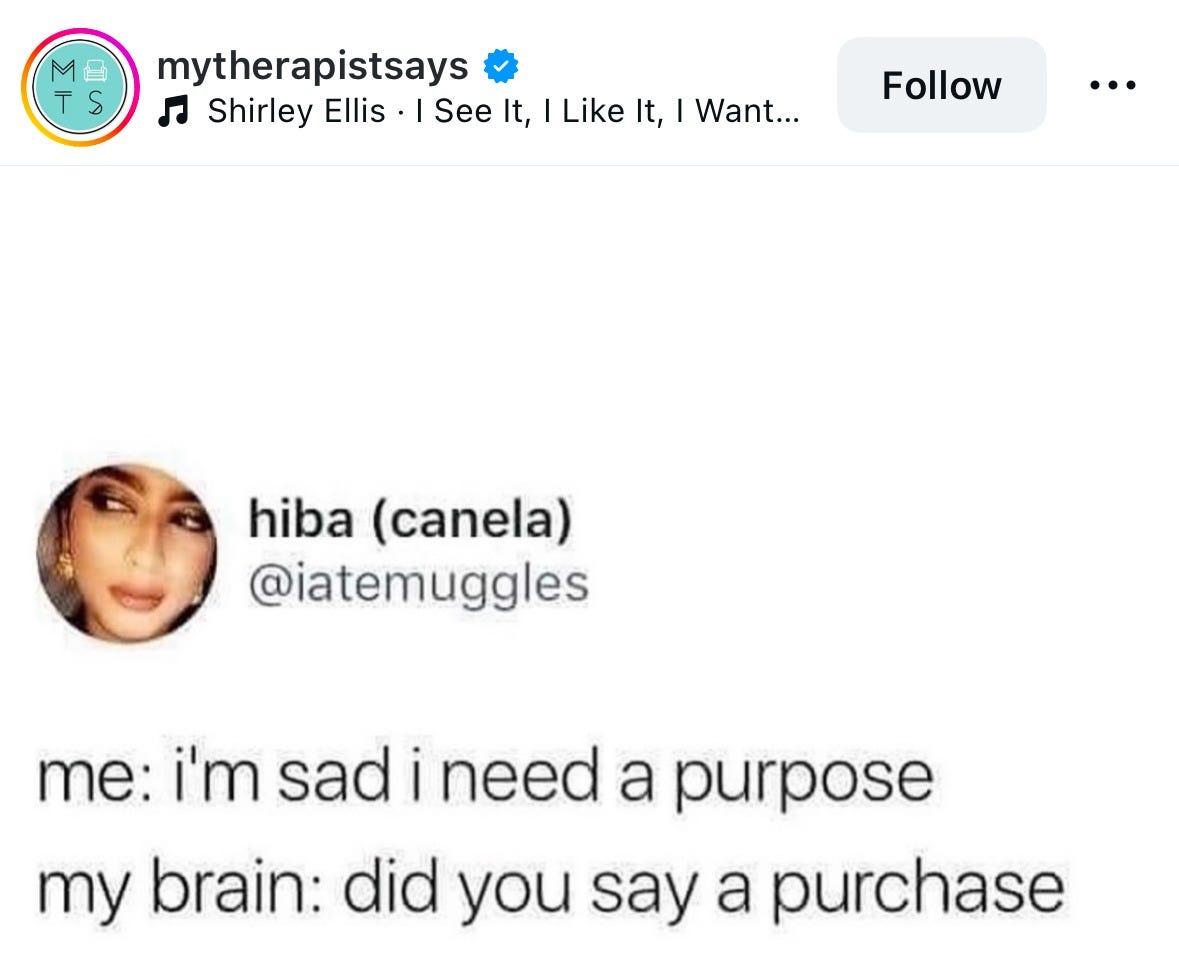
When this image popped up in my IG feed, I cracked up. I don’t know about you, but my brain does love that dopamine spike it gets from smashing the “Buy It Now!” button. But then I realized...there’s something a little deeper going on here, something a bit more insidious than we might guess at first.
Our desire to “do something” with our lives has been co-opted and commodified, trained to transform a desire to move toward purpose into an impulse to buy and acquire new stuff. Goals have become a mechanism for this transformation—and I think we need to ask what we’ve lost along the way.
What We’ve Lost
Lewis Mumford once observed that, in the transition to an industrialized society, “eternity ceased gradually to serve as the measure and focus of human actions.” There was a time when eternity—the full flourishing of human life and our ultimate home—measured and focused how we lived our lives. But somewhere along the way, we lost that horizon. And when we did, something else had to fill the void.
Before we get to what that was, though, we need to ask a more fundamental question: What kind of creature are we, anyway?
Every approach to living assumes things about human nature. The “goals” approach assumes we are primarily achieving creatures—beings whose fundamental orientation is toward acquiring and completing. But the Christian tradition suggests that we are, first and foremost, desiring creatures—oriented by love toward some vision of the good life. We’re not static containers for ideas; we’re dynamic, always on the move, pursuing something. I love how James K.A. Smith puts it: we’re like existential sharks—we have to move to live. We are becoming creatures, directed toward something, pursuing some larger vision of life.
Smith goes on to suggest that we are shaped far more by practices and rhythms than by ideas alone. Our deepest desires don’t show up primarily in what we say we want, but in what our daily life and habits reveal we want. You can tell what someone truly loves not by asking them, but by watching how they spend their time.
If we’re creatures oriented by desire and shaped by practice, then our ultimate orientation matters immensely. Where are we being formed to desire? What are we becoming? This is where eternity enters the picture—not as abstract doctrine but as the horizon of our becoming.
The Christian vision of eternity isn’t about endless tomorrows where nothing matters because there’s always another day. That’s the critique philosopher Martin Häggland makes—that a belief in, a life oriented toward, eternal life removes all stakes, leaving us with meaningless succession. And honestly, if that’s what eternity really is, he’d be right to reject it. A lot of us carry that image around, whether we’d admit it or not.
But that fundamentally misunderstands what eternity is.
Eternity is greater aliveness, not infinite extension. C.S. Lewis suggested something like this in The Great Divorce: we can think of our lives here as practice, and who we are now is who we will continue to be in eternity—only intensified, brought to full flourishing. This long view creates proper stakes. It gives us a measure for our actions that transcends the tyranny of the urgent, the anxiety of productivity metrics, the exhaustion of endless achievement.
Purpose—that sense of what we’re oriented toward, of who we’re becoming—expresses our longing to see all things made new.
But when we lost eternity as our measure and forgot our nature as desiring, becoming creatures, something else rushed in to fill the void. Goals—with their promise of achievement and their focus on getting rather than becoming—became the default measure for a meaningful life.
The problem is, they can’t bear that weight.
When Goals Become Our Measure
Goals now carry the burden that eternity once carried. What began as a theological claim about grace—that hard work signals divine favor—became an individualist achievement ethic. We lost “eternity as measure” and kept only the anxious striving. Goals have become the container for that anxiety.
They’ve become the answer to “what makes life important or successful?” But they’re too small for that role, too focused on acquisition rather than formation (though they do, in fact, form us). And perhaps most importantly, they take our nature as desiring and becoming creatures and warp it into unrecognizable shapes.
The clearest evidence of this failure is what psychologist Tal Ben-Shahar calls the “arrival fallacy”—achieving a goal we’ve pursued, expecting lasting fulfillment, only to find that happiness disappointingly elusive. You get the promotion, lose the weight, publish the book, buy the house—and then what? The achievement becomes the new normal almost immediately, and we set our sights on the next milestone.
This happens because we’ve made goals into absolute statements of identity. We invest them with the expectation that this achievement will finally make us who we’re meant to be. So when we don’t reach the goal, we haven’t just failed at a task; we’ve failed at being ourselves. And when we do achieve it, it becomes just another marker pointing to the next thing that really will complete us. This time. For real.
This identity problem shows up in two crucial ways. First, when goals carry our identity, every setback feels existential. It’s not “I failed at this specific thing.” It’s “I failed at being me.” Goals detached from any deeper purpose become either arbitrary (why this goal and not another?) or anxiety-producing (what if I don’t make it?). The finish line keeps receding, and we’re left exhausted, chasing something we can never quite reach.
Second, goals disconnect us from the very behaviors and processes that actually shape us. We’ve designed goals to end—you either fail or achieve them, and then move on. There’s no lasting satisfaction because goals aren’t designed for satisfaction; they’re designed for completion. This is the opposite of practice, which is ongoing, formative, and focused on presence rather than outcomes.
Ask me how I know.
I’ve tried the goal-setting thing faithfully. Quarterly planning, concrete OKRs, recording targets, linking them to monthly projects, delineating tasks, reviewing progress. The whole productivity stack. And you know what? It was demoralizing. I’d see all these tasks ticked off with no discernible effect on the results I wanted. The goals never connected to my actual behaviors, my contexts, my relationships, the daily life where I actually lived.
I realize now that goals effectively set their object apart from everyday life, as if to say: “This is a thing separate from your world BUT! It will reshape that world if you accomplish it. So accomplish it OR ELSE.” Goals became referendums on who I was, not projects in becoming who I’m designed to be.
Goals assume we’re achieving beings when we’re actually becoming beings. Achievement culture offers us this container for living without ever asking “toward what end?” We’re given tools for efficiency without any sense of direction, like being handed a high-performance engine with no steering wheel.3
We need something more stable, something that aligns with our nature as creatures oriented by desire and shaped by practice. We need purpose.
Purpose as Proper Measure
Purpose recovers our sense of what kind of creatures we are. Unlike goals—which change, shift, get achieved and replaced—purpose provides a stable orientation. It expresses our longing to see all things made new, our glimpse of eternity breaking into the present. Purpose “stains backwards” through our lives, as it were, reshaping what we see and imagine, claiming stakes in the world as it ought to be.
When we have purpose, we can act as if we live in that world already—and in doing so, we bring the kingdom of God a little bit closer to now. Purpose says nothing about specific outcomes, whether we’ll get what we want or like what we get. Instead, it describes something that doesn’t fully exist yet, but remains compelling enough to sustain us in the journey, like lembas bread for the long journey.
Here’s three ways that purpose functions differently than goals:
Purpose as Destination
Purpose orients us toward who we’re becoming, not what we’re getting. A destination isn’t the same as a goal, though. A goal is a specific, measurable outcome: “lose 20 pounds,” “make $100k,” “publish a book.” A destination is more like “becoming the kind of person who cares well for their body,” “becoming generous and free from financial anxiety,” “becoming someone who creates beauty and meaning through words.”
Goals are about getting. Purpose is about becoming. And becoming takes time, patience, attention to daily formation—all the things goals tend to short-circuit.
Purpose as Standard
Purpose also provides a measure by which we evaluate our choices and behaviors. It lets us ask whether our present actions align with our deeper convictions about who we’re designed and called to become. Remember: our deepest desires manifest in our daily life and habits, not just our stated intentions. Purpose connects the big picture to the daily practices that actually form us. It asks not “did I hit my target?” but “is this shaping me into who I’m meant to be?”
This asks a lot more of us than goal achievement, honestly. You can achieve a goal and still be oriented in completely the wrong direction. Purpose keeps asking the harder question: which way am I going?
Purpose as Filter
Finally, purpose helps us navigate the overwhelming smorgasbord of modern options. It helps us see which option better enables us to move toward our destination and which moves us away from it. When you’re facing several equally good options—this job or that one, this city or another, this commitment or a different one—purpose becomes the filter that makes the choice possible. Not because it gives you a formula, but because it reminds you who you’re becoming and lets you ask: which of these fits that becoming?
From Goals to Projects
So what do we do with goals? I’m not suggesting we abandon all structure or direction. Rather, I’m suggesting we dethrone goals from their position as the ultimate measure and make them subject to purpose.
When you have purpose as your north star, goals become experiments in living out that purpose rather than referendums on your identity. Failed experiments teach you more about how to express who you’re becoming; they don’t mean you’ve failed at being yourself.
In future essays, I’ll explore the practical framework—how commitment spheres help us locate purpose in actual domains of life, how projects and experiments become ways of honoring commitments in a given season without turning into identity referendums. But for now, the crucial shift is this: start with purpose, not goals.
An Invitation
So let me ask: What would change if you started with purpose rather than goals?
I won’t pretend discovering purpose is quick or easy. It’s not another productivity hack. It’s about recovering our nature as desiring, becoming creatures. It’s about taking the long view that eternity provides—not to escape the present but to measure it rightly.
Purpose is our glimpse of eternity. It’s the expression of our longing to see all things made new. It’s the measure and focus that our actions desperately need. Not so we can achieve more, but so we can become who we’re designed to be.
And that, my friends, sounds far more compelling than any goal.
Take a look at how you responded to last week’s SloDo.
Has anything from this essay illuminated, transformed, or otherwise changed about your response?
Let’s be hopeful, creative, and wise—together.
Shalom,
If this essay resonates but leaves you wondering how to actually live this way given your real constraints—the competing responsibilities, limited energy, complex realities—you're not alone. Systems Therapy helps bridge that gap with personal productivity solutions that honor your whole design.
Use this worksheet to take notes!

Also: A Note About AI
I use LLMs (or chatbots, or Clippy’s sophisticated older cousin) at the END of my writing process. This helps me edit the work, zoom out to find patterns I’ve missed, and generate social media posts, title ideas, and other related tasks that make me want to shrivel up in a corner and die. The blood, sweat, and tears are wholly my own.
Had I better timing, I could have scheduled this to publish in January, the season of freshly-minted goals, rather than March. Alas, I am not that with it, so here we are. Let’s dive in, shall we?
This essay is shaped by Oliver Burkeman’s Four Thousand Weeks (on time and finitude), Tara McMullin’s What Works (on goals and validation), Simon Sinek’s Start With Why (on motivation), James K.A. Smith’s Desiring the Kingdom (on formation and desire), Parker Palmer’s Let Your Life Speak (on vocation and discernment), Maria Bowler’s Consistency Reimagined workshop, and the Christian tradition’s long conversation about discipleship and eternity. I’m familiar with, but haven’t read in full yet, Martin Hägglund’s This Life: Secular Faith and Spiritual Freedom. I also found these videos helpful: “Set Intentions, Not Goals” and “You’re Not Lazy, Your Goals Just Suck.”