

Building a System That Fits a Human Life
Focal Things • Sustainable Systems

Sustainable Systems provides purpose-focused humans with deliberately designed processes, tools, and practices that are sustainable, meaningful, and beautiful.
As I shared earlier this month, I spent years building elaborate productivity systems that eventually broke me. I learned the hard way that sophisticated tools can become sophisticated avoidance—a way of perfecting process while dodging the vulnerable work of actual output.
So this week, I want to share my Focal Things—the principles, processes, and practices I’m actually using now. Not because they’re “right,” but because they fit my real limits and values. They help me live a purpose-focused life in a sustainable, human-scale way.
This isn’t a minimalist manifesto or a rebellion against complexity. It’s about listening to constraints that foster clarity—of purpose and practice.
Lemme say it for the back seats: You totally should not do what I do.
Your limits, energy rhythms, and season of life are different. My setup only matters as an example of what it looks like when someone stops chasing the perfect system and starts working with their actual life.
The goal isn’t to have an impressive or “special” system. It’s to have one that helps you work with who you are, not one that forces you to become someone else.
Still, the questions and principles that helped me find my way might help you find yours. So I’m sharing my current setup not as a template to copy, but as an example of what it looks like when we stop chasing the perfect system and start working with our actual lives.
Think back to this month’s SloDo, where you reflected on the stories you tell about your capacity, energy, and organization. Think also about anything that resonated for you in reading “When Your Productivity System Breaks You.” Use this worksheet to take notes!

Common Productivity Pitfalls
Over the years, I’ve seen three main traps that keep people stuck: cycling through systems, drowning in tools, and chasing perfection. Each one looks different on the surface, but they all grow from the same root—avoidance.
Tool-Hopping: Mistaking Movement for Progress
You know the pattern: a new app promises to fix everything. You spend hours setting it up, migrate all your data, learn every feature. It works—for about three weeks. Then it doesn’t. So you start researching the next one.
I did this for years. Eventually I had to admit: the system wasn’t the problem. Researching tools at 11 p.m. instead of doing the work? That’s avoidance. Watching YouTube tutorials about productivity instead of producing? (Sing it with me.) Avoidance.
Ask yourself: What am I actually avoiding by switching systems?
For me, it was the vulnerability of sharing creative work that might be ordinary. For you, it might be something else—failure, success, the discomfort of not knowing.
So I made a simple commitment: no system changes for six months.
Not because this setup is perfect, but because stability itself is the practice. Learning to work with what I already have teaches me something no perfect system ever could.
Tool Overload: When the System Becomes the Work
Maybe you don’t switch tools—you just keep adding them. One app for tasks, another for notes, a third for highlights, a fourth to connect them all. Each one made sense at the time, but now you spend more energy managing the tools than doing the work.
Start by asking: What am I actually trying to do?
Not “what do productive people do?” or “what might I someday need?” What’s right in front of me?
Then ask: What’s the simplest tool that lets me do that?
For most of us, it’s simpler than we think: a notebook, a phone app, a list. The sophistication you need will grow naturally from the work itself. You don’t need to anticipate every scenario. You just need to start.
Yes, you’ll lose things—saved articles, elaborate setups. Let them go. What’s truly needed will come back when you need it. I promise.
Perfectionism: Waiting for the System That Never Arrives
Nothing ever feels quite right. You tweak, adjust, tinker. You tell yourself that once the system is perfect, then you’ll do your best work. Hi, it me. 👋
Here’s the truth: there is no perfect system. There’s only the one that works on a Wednesday after three hours of sleep.
I have insomnia, and at 46, it hits harder than it used to. One morning I woke up at 3 a.m. and knew my plans for the day were shot. In my old setup, that day would’ve crumbled. With my new approach, I looked at my list, decided which tasks I wasn’t willing to give up, and deleted the rest. The work still got done. The sky didn’t fall.1
Good enough means the system works on your worst day, not just your best. It’s the one you can maintain at seventy percent capacity. Build your system for that person—the one who gets tired, distracted, human.
This isn’t settling. It’s accepting that human-scale lives require human-scale solutions.

Principles and Questions That Keep Me Grounded
When I dismantled my old, over-engineered setup, I realized I needed a few guiding principles—not rules, but checkpoints2—to keep me from sliding back into old habits.
Focus on Process Over Outcome
All I can control is showing up. Measuring success by outputs—views, likes, revenue—pulls me away from faithfulness to the practice itself.
Ask yourself: What would showing up faithfully look like in your life, regardless of results?
If you’re a parent, maybe it’s reading to your kids even if they don’t listen. If you’re a creative, it’s putting marks on the page whether they’re brilliant or not.
Create Rhythms That Reduce Decision Fatigue
Decision fatigue drains energy faster than hard work. So I’ve built rhythms that make showing up automatic.
For me: designated days for client work, one weekly review, one creative block. For you, maybe a morning routine, a recurring check-in, or a fixed workspace.
Ask: Where am I making the same decision over and over? What rhythm could remove it?
Pay Yourself First
If I wait to “earn” creative time by finishing everything else, it never comes. So I start most mornings with research or writing—the work that matters most but is easiest to postpone.
Ask: What’s the work I keep saying matters but never make time for?
Practice Presence Over Hoarding
It’s okay to appreciate what others have created, then let it go. I don’t need to save everything. I used to collect articles, quotes, screenshots—just in case. Eventually, the archive became a graveyard for good ideas.
Now I save only what’s relevant to current work. When I trust myself to remember what matters, I notice more.
Ask: What am I afraid will happen if I don’t save this?
These four principles keep my system human. They remind me that the goal isn’t optimization—it’s formation.
Friction as Formation
Most productivity tools promise ease: automate everything, capture everything, connect everything. The result? A digital museum of things you might use someday.
That’s why I love Milanote now.
For years, I hated it—no automation, no clever imports, no integrations. But that limitation became its strength. Milanote forces me to add things manually, one at a time. That friction makes me ask, Is this actually relevant to what I’m working on right now?
Here’s how it works for me:
My home screen shows active writing projects, using emojis by stage—researching, incubating, publishing.
I update them intuitively, not by rule: when a project feels like it’s sprouting, I move it forward.
I do the same with books—some I’m dipping into slowly, some actively engaging, some finished but still resonating.
This creates a “heat map” of my creative life. When too many projects pile up in the “sprouting” phase, I pause and ask: Am I still curious about this? If not, I close it or let it lie fallow.
What stays is what’s shaping me now. What falls away doesn’t matter anymore.
We live in a culture that treats people like machines—optimize everything, automate everything, scale everything. But sometimes the friction is the formation.
Friction slows you down enough to choose.
Friction reminds you what matters right now.
Friction teaches discernment.
Milanote isn’t for everyone, and it’s not trying to be. But for me, that friction restored a human pace. Check out my video where I give a quick walk-through.
My Simple System of Human-Scale Tools and Rhythms
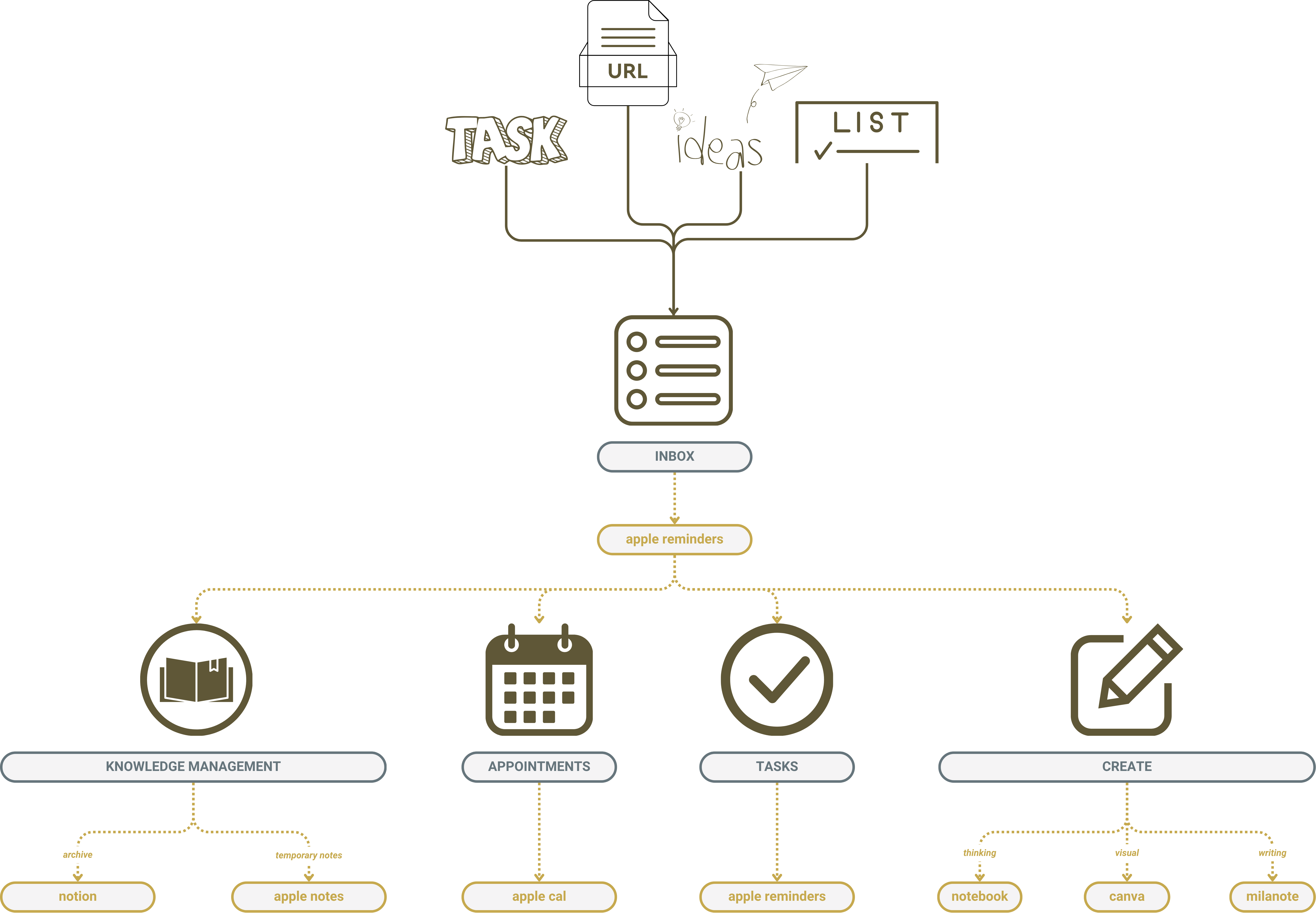
After years of complexity, I’ve reduced everything to a few rhythms and tools that serve clarity instead of control.
Rhythms: Working With Energy, Not Against It
Monday–Thursday: client work, admin, email, reading—split into two-hour blocks with rest in between.
Friday: transition and review day. I clear inboxes, reflect, and reset for the week ahead.
Saturday: exploration—no structured work, just life, walks, tacos.
Sunday: deep creative flow—long writing sessions, incubating ideas.
These rhythms accept that I don’t have consistent energy. Working with that truth has made me far more consistent than pretending I’m a machine.
Tools: Removing Barriers
One inbox for everything—tasks, ideas, notes. It gets messy mid-week, then cleared Friday.
One calendar showing both appointments and committed tasks so I can see true capacity before saying yes.
Temporary space for references that self-delete monthly.
An archive for finished work—not a daily playground.
A single writing space for current projects only.
A physical notebook for weekly plans and questions.
These tools aren’t optimized; they’re sustainable. Each earns its place by reducing friction, not adding features. Your specific tools3 might look completely different.
Reviews: Cultivating Awareness, Not Metrics
Every Friday morning, I spend thirty minutes reviewing the week. Three columns: Plus (what worked), Minus (what didn’t), Next (what’s coming). Once a month, I reflect more deeply:
Where did I notice God at work?
Where was I most alive?
Where did I work with my design versus against it?
That’s it. Awareness over achievement.
Learning to Trust Simplicity
Some weeks this system hums; some weeks it barely holds together. Both tell me something about capacity, not failure.
I still wrestle with transitions—from intake to output, from saving to creating. I still forget that pain, fatigue, and limits are non-negotiable. But I’m learning: my limitations aren’t defects. They’re conditions for becoming.
So I keep asking: Is this helping me work sustainably, or am I trying to engineer my way out of my limits?
Here’s what I’ve stopped doing:
I don’t track time unless a client needs it.
I don’t auto-save highlights or collect quotes “just in case.”
I don’t build automations to make my system clever.
I don’t use entertainment apps on my phone—it’s a tool now, not a companion.
Each “no” protects a more important “yes.”
And here’s the practice that changes everything: showing up with what I have, even when it’s messy.
Because the point isn’t the system. It’s becoming who you’re designed to be. That happens through imperfect, faithful presence—trusting you already have enough to do the work that’s yours right now.
So ask yourself:
What systems are you maintaining that you don’t actually trust?
Where are you over-engineering instead of accepting?
What would it look like to work with your design instead of trying to fix it?
Maybe simplicity isn’t a downgrade. Maybe it’s how we learn to live as humans again.
If the idea of setting a match to all your systems sounds like fun, maybe we should talk. Just click the button to learn more.
Let’s be hopeful, creative, and wise—together.
Shalom,
As my mom likes to say, “Some days you get the bear. Some days the bear gets you.”
Cuz rules invite rebellious resentment, ya feel me? No? Just me?
For Reference: My Specific Tools
Sometimes specific examples give permission to keep things simple. So if it’s helpful to know exactly what I’m using, here you go:
Apple Reminders for my Inbox and IFO 🛸 lists. (Identified Flying Objects = tasks)
Apple Calendar for seeing capacity (integrates appointments and Reminders with do dates)
Apple Notes for temporary holding (with a 30-day review to delete outdated stuff)
Notion as archive only (with a 90-day review to delete outdated stuff)
Milanote for writing space only (like this essay!)
Physical notebook for weekly planning (I’m a fan of Hemlock & Oak)
But again: these specific tools matter far less than the principles they embody. Use what you have. Start simpler than seems reasonable. Trust yourself more than the system.